Category: Analog Electronics
-

The Light Emitting Diodes, Lecture-XIII.
We have been discussing a lot about what are diodes, their characteristics and their application in the electrical and electronics industry. You must have heard about the durable and power efficient LED bulbs. Do you know they are made from diodes? YES. Semiconductors: they are ubiquitous. Today we will discuss about the light emitting diodes.…
-

Zener diode and voltage regulation, Lecture-XII.
Today we will discuss the Zener diode. Zener diodes get applications in various facets of electronics and electrical circuits. But we will focus on the most basic application of the same in voltage regulation. In our lecture-VII we discussed the current-voltage (IV) characteristics of the diodes, under forward and reverse bias, in detail. Lets recapitulate.…
-
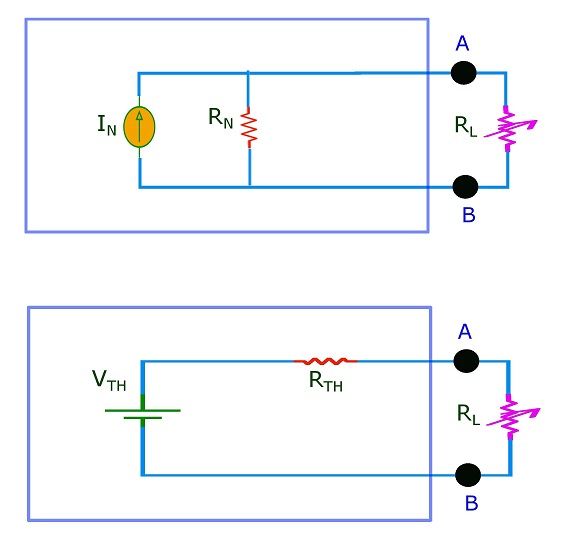
Thevenin’s and Norton’s theorem.
Today we will discuss the idea of current and voltage sources and the related Norton’s and Thevenin’s theorems. These are immensely useful in understanding many electrical circuits. The content was understood from the “electronic principles, 7th edition” by Albert Malvino and David J Bates, a text which I also followed in developing some of the…
-

Bridge type full wave rectifier, Lecture-XI.
In our last lecture we discussed the center tapped full wave rectifier and derived its most important parameters. Check that lecture for a conceptual continuity with the present lecture. Prior to that we discussed in much detail the case of the half wave rectifier and its parameters. Those two lectures can be accessed here. Today…
-

Center tapped full wave rectifier, Lecture-X
In our last two lecture we discussed in all detail the half wave rectifier which is constructed from an ideal diode and studied its various parameters such as its rectifier efficiency and transformer utilization factor. Please have a look at these lectures as the same will have an indubitable bearing on what we will discuss…
 M Dash Foundation: C Cube Learning