Mindblown: a blog about philosophy.
-
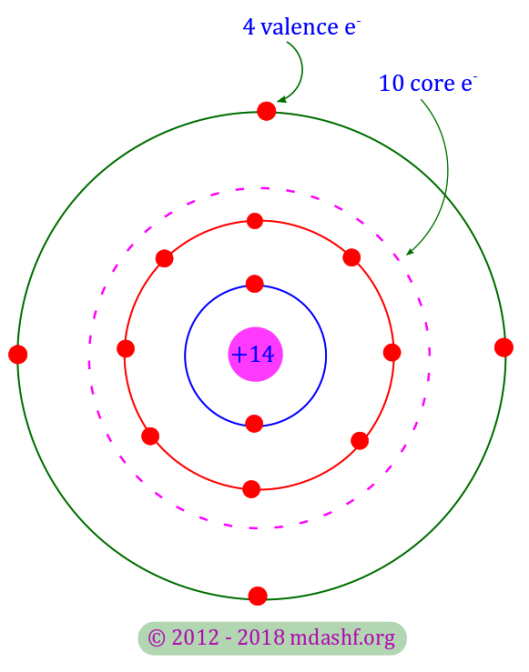
Conductivity and mobility in semiconductors, L-III
We will discuss in this lecture about drift velocity of electrons and holes in semiconductors which leads to the conductivity and mobility of free charge carriers in the same. To smooth-sail through this lecture you might wanna first brush up the concepts discussed in the last two lectures: lecture I and lecture II. Lets begin…
-
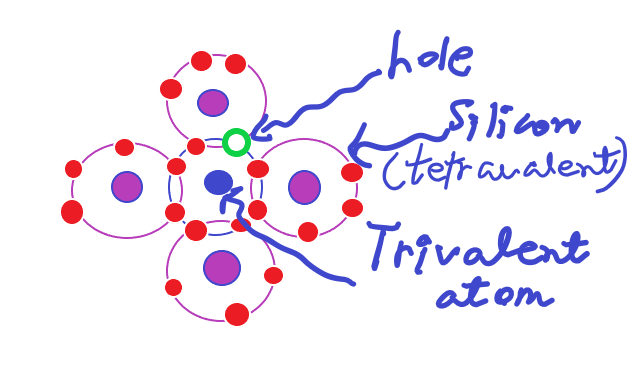
Semiconductors and charge carriers (L-II)
In our last lecture (L-I: lecture-I) we discussed how there are two types of charge carriers in a semiconductor; the electrons and the holes. We also discussed what are intrinsic semiconductors. i. An intrinsic semiconductor has an equal number of electrons and holes. These are produced due to thermal excitation when an electron is dislodged…
-
Patriarchy
Most people out there would misunderstand the word patriarchy. They take it to mean: fatherly-rule or “through rule of the son from the father”. In-fact more than 200 years ago they constructed a new word matriarchy to counter this “sexism”. This new word meant passing of rights through mother’s side. While societies have been greatly…
-
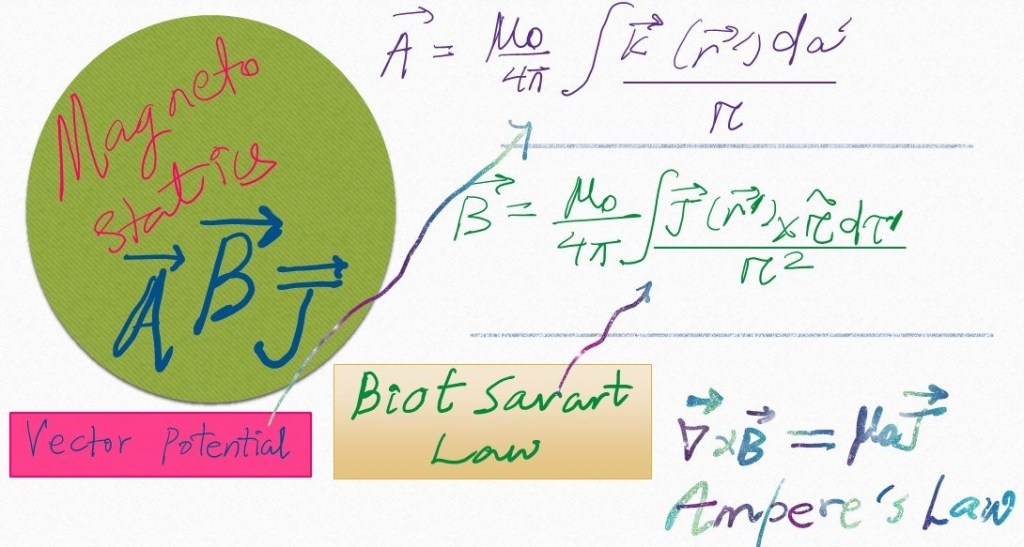
Magnetic vector potential of a rotating uniformly charged shell.
Today we will solve the problem of finding magnetic vector potential of a rotating, uniformly charged spherical shell. We won’t discuss the general idea behind the vector potential (how it follows from Helmholtz theorem, and gauge freedom etc) and how its defined. That will be part of a conceptual lecture and will be available when…
-
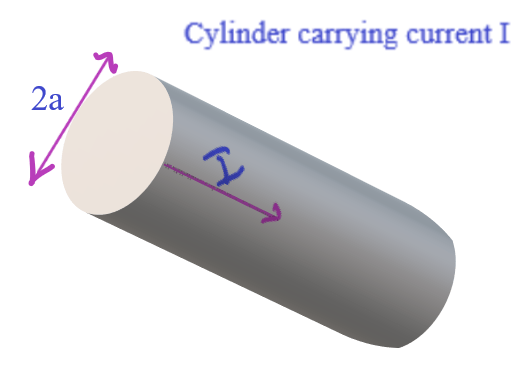
Problem 5.13 Application of Ampere’s Law.
Yesterday we saw an interesting application of the Ampere’s Law (– in magnetostatics and sometimes called Ampere’s circuital law also) for the infinite uniform surface current. Today we will see yet another display of the elegance and efficacy of this law in the following problem. This problem is inherited from Griffith’s text on Electrodynamics (3rd…
Got any book recommendations?
 M Dash Foundation: C Cube Learning