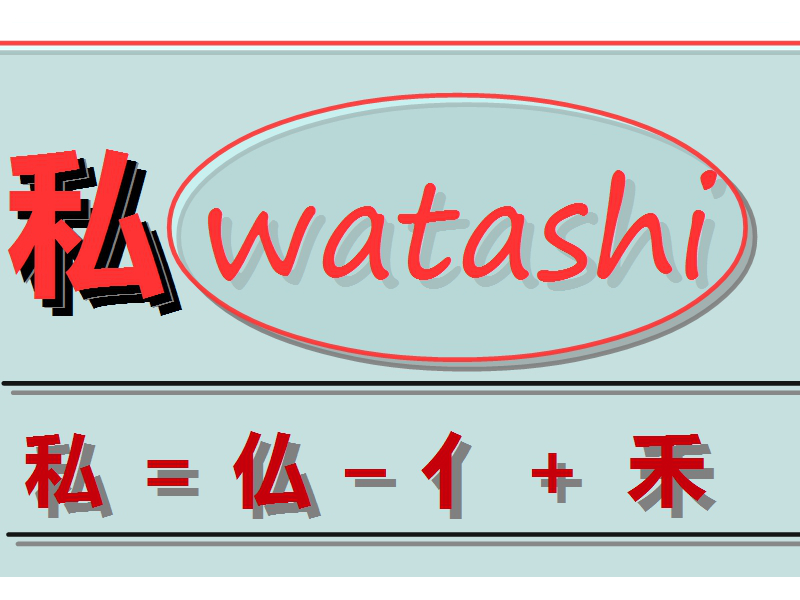
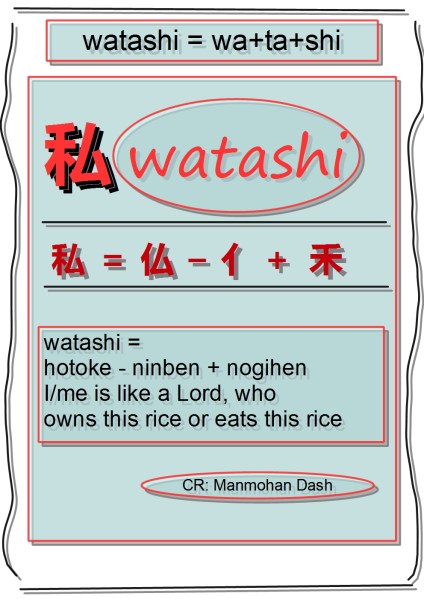
After writing this article, this is what I realized, following a pattern of what would be called “kanji equations” the kanji for watashi also follows a kanji equation; 私 = 仏 − 亻+ 禾. [watashi = hotoke – ninben + nogihen] (says I/me is like a Lord, who owns this rice or eats this rice) Check the image in the bottom.
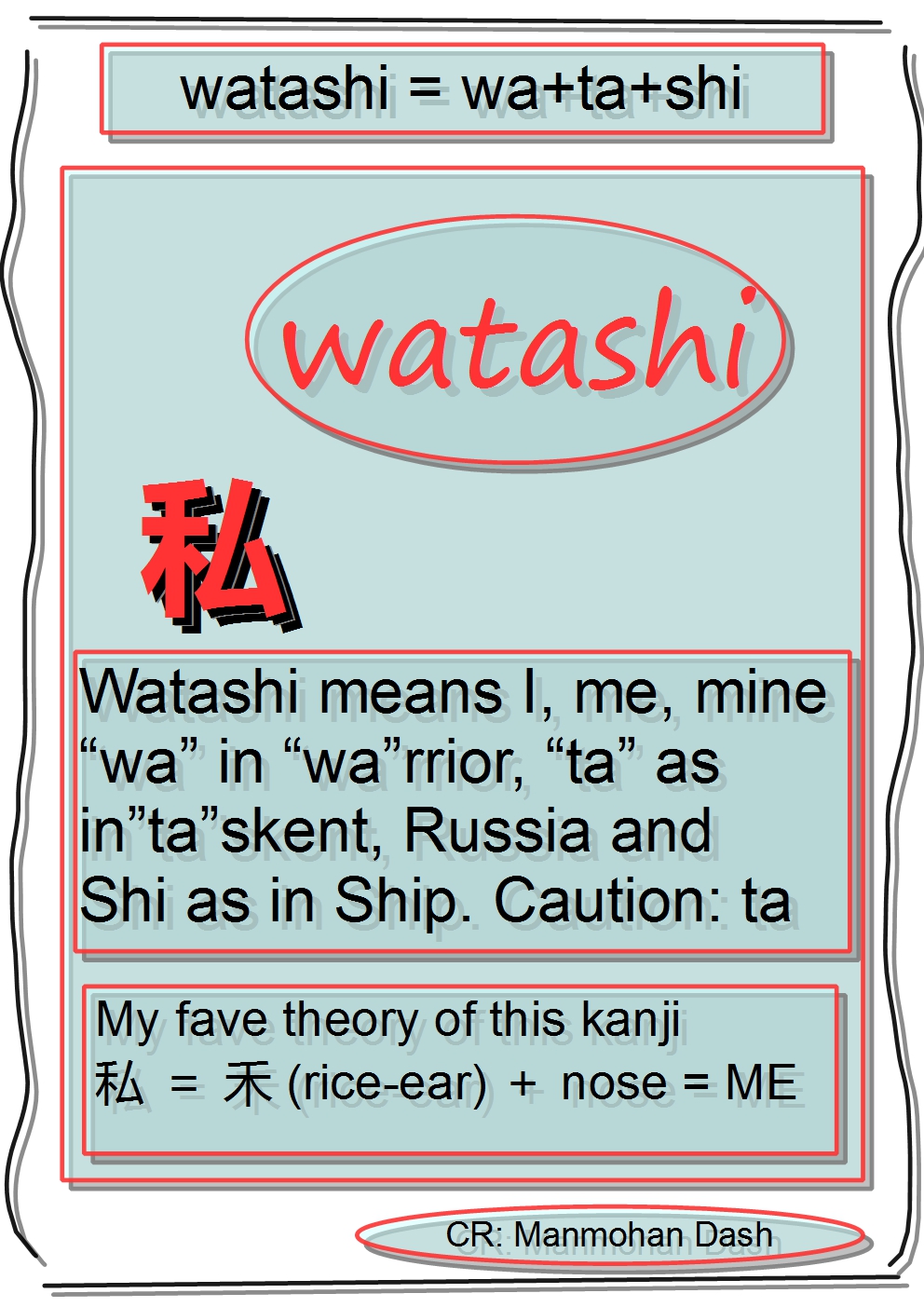
How to say “I” (me or mine) in Japanese; wa’ta’shi.
Note that: a real distinction between I, me or mine comes from what are called “particles”. It defines; to-I, by-I, on-I, From-I etc. The few help-objects that does so (by, to, from, on, in … ) in strictly phonetic language like Japanese or Indian languages are called as Particles. (Be rest assured particles have never been studied formally in Indianic languages, at-least as particles.)
Note also that: (I have said this somewhere in last 1 year or more, wata is whats rice in Indian, written vat or bhat, that what the 1st kanji is here, its called nogi-hen or nogi part. nogi is rice, or ear of rice, which is why this kanji looks like a rice-ear, the plant-tip. shi is like ji or shri. It could be that rice just denotes the Lord, farmer, owner etc. Nose then gives the human depiction. I or me to be known as “I who eats this rice” or “I who owns this rice” etc)
Note; if you want to see this word from Sun-unified theory of language: watashi is matashi = mahata-shri or maharaj etc which are only depiction of Sun-the-Lord and applicable as: Me/I. In Odia eg ambhe and ame (we ) in reference to one-self is taken as arrogance that befits maharaj or King or Lord. But it comes from Amiy = Sun.

 M Dash Foundation: C Cube Learning
Leave a comment